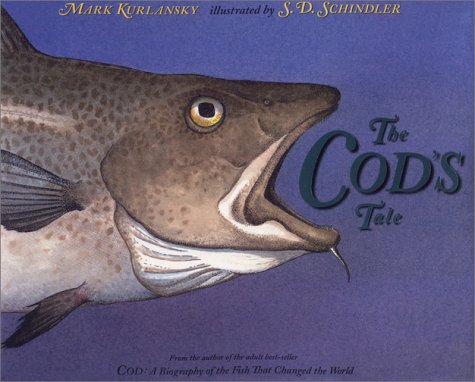
THE COD'S TALE by Mark Kurlansky; Illustrated by S.D. Schindler (G.P. Putnam, 2001)
GENRE: Nonfiction / History
HONORS: Orbis Pictus Award
REVIEW: Every aspect of The Cod's Tale has been carefully chosen and meticulously executed, making this a surprisingly interesting mediation on history, zoological science and environmentalism all filtered through the lens of that most unglamorous of fish, the cod. Kurlansky's voice is straightforward and frank, crediting the reader with interest and intelligence without lapsing into didacticism. Schindler's watercolor illustrations are humorous and appealing in their detail, while the maps and timelines compliment and support the text. In addition to a wide range of well-chosen facts, Kurlansky also includes side bars with supplementary quotes, stories and even recipes, drawing the reader further along into the narrative of the cod's once robust presence in the oceans to the species' desperately dwindling numbers. Even more impressive is the fact that Kurlansky manages to convey the global import of this under-considered fish through structure alone. By opening with the cod's place in the oceanographic hierarchy and then narrowing down to the history of how humans have used the fish before widening one again to ponder the environmental impact of overfishing, Kurlansky gives import and interest to a topic that would not, intuitively, have either.
OPINION: Although The Cod's Tale is, ostensibly, a picture book, the level of detail and thought that has gone into it's making elevates it to the level of any nonfiction chapter book, and certainly above most textbooks, based on interest alone. A book that demands thought and consideration, it is still an accessible and engrossing read while being undeniably informative.
IDEAS: A good addition to Earth Day or oceanographic displays. Also a strong suggestion for students interested in topics on environmental impact and the history and influence of food in western culture (and particularly in America).
Showing posts with label history. Show all posts
July 23, 2012
July 16, 2012
Cleopatra VII: Daughter of the Nile
CLEOPATRA VII: DAUGHTER OF THE NILE (Royal Diaries) by Kristiana Gregory; Narrated by Josephine Bailey (Tantor Media, 2006)
GENRE: History - Fiction / Audiobook
HONORS: None
REVIEW: In this well-researched fictional account of Cleopatra's early life, Kristina Gregory presents a portrait of the young princess that renders her both incredibly impressive and warmly human. The "diary" begins when Cleopatra is twelve years old. Having survived an assassination attempt, Cleopatra's father, Ptolemy XII, flees Egypt for Rome where he intends to garner the money and support of Julius Caesar and the Roman Senate. Fearing for her life (with good reason) Cleopatra joins him. The diary chronicles her Cleopatra's time in Rome and her well-executed efforts to make herself worthy of being Queen. Though already quite self-aware, Cleopatra grows in wisdom through dedicated effort so that by the time she reaches her fourteenth year, one can easily see the formidable Queen she would become. While the book itself is wonderful, Josephine Bailey's narration truly made the audio version stand out. Fluid and compelling, her voice brought Gregory's prose, and Cleopatra, to life.
OPINION: The first in the Royal Diaries series, Cleopatra VII is a surprising balance of entertainment and scholarship. Though little is actually known about Cleopatra's early life, Gregory uses what primary sources are available to piece together a viable picture of the Queen as a girl. The diary format, as always, lends immediacy to the story while providing the author with plenty of opportunity to slip in exposition and historical detail. Educational and compelling, it's a great addition to a library's collection.
IDEAS: Cleopatra remains a fascinating figure, while ancient Egypt is enjoying a surge in popularity thanks to films like The Mummy and books like The Red Pyramid by Rick Riordan and Theodosia and the Eye of Horus by R.L. LaFevers. A great suggestion for fans of either series, Cleopatra VII is also a good read for tweens interested in ancient Egypt, Rome or the great Queen herself.
GENRE: History - Fiction / Audiobook
HONORS: None
REVIEW: In this well-researched fictional account of Cleopatra's early life, Kristina Gregory presents a portrait of the young princess that renders her both incredibly impressive and warmly human. The "diary" begins when Cleopatra is twelve years old. Having survived an assassination attempt, Cleopatra's father, Ptolemy XII, flees Egypt for Rome where he intends to garner the money and support of Julius Caesar and the Roman Senate. Fearing for her life (with good reason) Cleopatra joins him. The diary chronicles her Cleopatra's time in Rome and her well-executed efforts to make herself worthy of being Queen. Though already quite self-aware, Cleopatra grows in wisdom through dedicated effort so that by the time she reaches her fourteenth year, one can easily see the formidable Queen she would become. While the book itself is wonderful, Josephine Bailey's narration truly made the audio version stand out. Fluid and compelling, her voice brought Gregory's prose, and Cleopatra, to life.
OPINION: The first in the Royal Diaries series, Cleopatra VII is a surprising balance of entertainment and scholarship. Though little is actually known about Cleopatra's early life, Gregory uses what primary sources are available to piece together a viable picture of the Queen as a girl. The diary format, as always, lends immediacy to the story while providing the author with plenty of opportunity to slip in exposition and historical detail. Educational and compelling, it's a great addition to a library's collection.
IDEAS: Cleopatra remains a fascinating figure, while ancient Egypt is enjoying a surge in popularity thanks to films like The Mummy and books like The Red Pyramid by Rick Riordan and Theodosia and the Eye of Horus by R.L. LaFevers. A great suggestion for fans of either series, Cleopatra VII is also a good read for tweens interested in ancient Egypt, Rome or the great Queen herself.
July 10, 2012
Nightmares and Fairytales: 1140 Rue Royale
NIGHTMARES AND FAIRY TALES Volume 3: 1140 RUE ROYALE by Serena Valentino; Illustrated by Crab Scrambly (SLG Publishing, 2007)
GENRE: Graphic Novel / Horror
HONORS: None (though the series has enjoyed many positive critical reviews)
REVIEW: Nightmares and Fairytales is a series of graphic novels wherein the uniting factor is a strange little doll called Annabel. Annabel is said to be cursed, but her current owner, a girl named Gwen understands her, so Annabel tells her stories of the horrors that she's seen. 1140 Rue Royale is one of Annabel's stories. Though an integrated part of the series, it can easily be read alone. It tells the story of a woman named Victoria and her niece who move into the house on 1140 Rue Royale - a house that is said to be haunted by the slaves who were tortured and killed there years before. What unfolds is a story full of foreboding and magnificent creepiness. Valentino's writing is perfectly paced, giving the reader just enough of a break between frightening occurrences to relax before she ratchets up the wrongness even more. Scrambly's illustrations are gorgeous and atmospheric - one part Edward Gorey, one part early Tim Burton - with odd angles and shadings that make you want to look over your shoulder. Everything about 1140 Rue Royale, it is based on the true story of Delphine LaLaurie, from the panel design to the narrative itself, is meant to sweep the reader along into a story that is dark and honestly horrifying (what was done to the slaves is diabolical). A beautiful, effecting and impressive work.
OPINION: The Nightmares and Fairytales series is, generally speaking, not one for younger adolescents, and some volumes should be consigned strictly to YA. 1140 Rue Royale is an exception, though I would only recommend it for those 12 and above, given the level of horror-style tension, some of the imagery and the violence that is implied. That said, 1140 Rue Royale is horror at it's best - driven not by blood and guts, but by a sense of injustice that must be avenged. Between Valentino's haunting story and Scrambly's evocative illustrations, it's one that the reader will think about long after it's been put down.
IDEAS: A good edition to any display containing darker fare, along with Neil Gaiman, Ted Naifeh etc., 1140 Rue Royale is a good suggestion for older tweens who are into Stephen King and serious poltergeist style ghost stories. Given the abuses to slaves that are depicted, it would also pair well with the Newbery award winning books, The Slave Dancer, Roll of Thunder Hear My Cry and The Dark Thirty: Southern Tales of the Supernatural.
GENRE: Graphic Novel / Horror
HONORS: None (though the series has enjoyed many positive critical reviews)
REVIEW: Nightmares and Fairytales is a series of graphic novels wherein the uniting factor is a strange little doll called Annabel. Annabel is said to be cursed, but her current owner, a girl named Gwen understands her, so Annabel tells her stories of the horrors that she's seen. 1140 Rue Royale is one of Annabel's stories. Though an integrated part of the series, it can easily be read alone. It tells the story of a woman named Victoria and her niece who move into the house on 1140 Rue Royale - a house that is said to be haunted by the slaves who were tortured and killed there years before. What unfolds is a story full of foreboding and magnificent creepiness. Valentino's writing is perfectly paced, giving the reader just enough of a break between frightening occurrences to relax before she ratchets up the wrongness even more. Scrambly's illustrations are gorgeous and atmospheric - one part Edward Gorey, one part early Tim Burton - with odd angles and shadings that make you want to look over your shoulder. Everything about 1140 Rue Royale, it is based on the true story of Delphine LaLaurie, from the panel design to the narrative itself, is meant to sweep the reader along into a story that is dark and honestly horrifying (what was done to the slaves is diabolical). A beautiful, effecting and impressive work.
OPINION: The Nightmares and Fairytales series is, generally speaking, not one for younger adolescents, and some volumes should be consigned strictly to YA. 1140 Rue Royale is an exception, though I would only recommend it for those 12 and above, given the level of horror-style tension, some of the imagery and the violence that is implied. That said, 1140 Rue Royale is horror at it's best - driven not by blood and guts, but by a sense of injustice that must be avenged. Between Valentino's haunting story and Scrambly's evocative illustrations, it's one that the reader will think about long after it's been put down.
IDEAS: A good edition to any display containing darker fare, along with Neil Gaiman, Ted Naifeh etc., 1140 Rue Royale is a good suggestion for older tweens who are into Stephen King and serious poltergeist style ghost stories. Given the abuses to slaves that are depicted, it would also pair well with the Newbery award winning books, The Slave Dancer, Roll of Thunder Hear My Cry and The Dark Thirty: Southern Tales of the Supernatural.
July 6, 2012
Case Closed? Nine Mysteries Unlocked By Modern Science
CASE CLOSED? NINE MYSTERIES UNLOCKED BY MODERN SCIENCE by Susan Hughes; Illustrated by Michael Wandelmaier
GENRE: History - Nonfiction
HONORS: None
REVIEW: Case Closed? is an attractive, easily readable book that successfully combines history and science to good effect. Arranged chronologically, the "mysteries" primarily involve disappearances - the mummy of Hatshepsut, ancient Egypt's controversial female pharaoh, the Anasazi pueblo peoples and Sir John Franklin's doomed expedition among others. The subjects range from the very familiar, (the disappearance of Anastasia Romanov), to the obscure, (the journey of the ancient explorer, Hsu Fu). All are engaging, though some more than others, and all synthesize the findings of experts in various fields, (medicine, archaeology, meteorology, etc), making this an engrossing, thorough and highly informative read.
OPINION: Wandelmaier's illustrations are attractive and accessible, making what might otherwise be a hard sell easy to pick up. In fact, everything about this book, from the text to the layout is designed to make the subject matter appealing to young people. That said, depth was not sacrificed for gloss - this book contains solid content that draws the reader in naturally. A great book and an excellent introduction to a number of subjects, Case Closed? should have in every library's juvenile nonfiction.
IDEAS: Great for a display on unsolved, historical mysteries, archaeology, science expeditions (both doomed and successful). Also a useful classroom reference.
GENRE: History - Nonfiction
HONORS: None
REVIEW: Case Closed? is an attractive, easily readable book that successfully combines history and science to good effect. Arranged chronologically, the "mysteries" primarily involve disappearances - the mummy of Hatshepsut, ancient Egypt's controversial female pharaoh, the Anasazi pueblo peoples and Sir John Franklin's doomed expedition among others. The subjects range from the very familiar, (the disappearance of Anastasia Romanov), to the obscure, (the journey of the ancient explorer, Hsu Fu). All are engaging, though some more than others, and all synthesize the findings of experts in various fields, (medicine, archaeology, meteorology, etc), making this an engrossing, thorough and highly informative read.
OPINION: Wandelmaier's illustrations are attractive and accessible, making what might otherwise be a hard sell easy to pick up. In fact, everything about this book, from the text to the layout is designed to make the subject matter appealing to young people. That said, depth was not sacrificed for gloss - this book contains solid content that draws the reader in naturally. A great book and an excellent introduction to a number of subjects, Case Closed? should have in every library's juvenile nonfiction.
IDEAS: Great for a display on unsolved, historical mysteries, archaeology, science expeditions (both doomed and successful). Also a useful classroom reference.
An American Plague
AN AMERICAN PLAGUE: The True and Terrifying Story of the Yellow Fever Epidemic of 1793 by Jim Murphy (Clarion Books, 2003)
GENRE: History - Nonfiction
HONORS: Newbery Honor (2003); Siebert Medal (2003); National Book Award Finalist (2003)
REVIEW: In the summer of 1793, Philadelphia, Pennsylvania was the temporary capital (and seat of the federal government) of the young United States. It was also a time bomb waiting to happen. Thanks to abnormally hot weather conditions and a wealth of mosquitos, dead animals, overcrowding and sewage back-up, it was also the site of one of the most devastating outbreaks of yellow fever in this nation's history. Well-researched and beautifully illustrated with archive prints, maps, letters and photographs, An American Plague unflinchingly details in the conditions that led to the outbreak, the heroism of the free blacks and doctors who tried to help the overwhelming number of sick, the medical practices of the time and the political crises that ensued. Murphy's hand is masterful and light, conveying historical detail with an immediacy that makes events 200 years in the past feel contemporary and relevant.
OPINION: An American Plague is one of the best works of nonfiction (for young people or adults) on medical history and the early days of the United States that I have ever read. Murphy's attention to detail is rivaled only by his instincts - he seems to know exactly how much detail to give. With such a gruesome disease, it would be easy to gloss over its affects, just as it might be tempting to relish the gory details. Murphy does neither, but sets a professional, yet accessible tone, while drawing the reader into a fascinating, if little known, tragedy.
IDEAS: A fantastic supplement to classroom discussions on the early federal government. Also a great suggestion for young people interested in medical history or researching the contributions of African Americans in history. Also pairs well with the novel, Fever 1793 by Laurie Halse Anderson.
GENRE: History - Nonfiction
HONORS: Newbery Honor (2003); Siebert Medal (2003); National Book Award Finalist (2003)
REVIEW: In the summer of 1793, Philadelphia, Pennsylvania was the temporary capital (and seat of the federal government) of the young United States. It was also a time bomb waiting to happen. Thanks to abnormally hot weather conditions and a wealth of mosquitos, dead animals, overcrowding and sewage back-up, it was also the site of one of the most devastating outbreaks of yellow fever in this nation's history. Well-researched and beautifully illustrated with archive prints, maps, letters and photographs, An American Plague unflinchingly details in the conditions that led to the outbreak, the heroism of the free blacks and doctors who tried to help the overwhelming number of sick, the medical practices of the time and the political crises that ensued. Murphy's hand is masterful and light, conveying historical detail with an immediacy that makes events 200 years in the past feel contemporary and relevant.
OPINION: An American Plague is one of the best works of nonfiction (for young people or adults) on medical history and the early days of the United States that I have ever read. Murphy's attention to detail is rivaled only by his instincts - he seems to know exactly how much detail to give. With such a gruesome disease, it would be easy to gloss over its affects, just as it might be tempting to relish the gory details. Murphy does neither, but sets a professional, yet accessible tone, while drawing the reader into a fascinating, if little known, tragedy.
IDEAS: A fantastic supplement to classroom discussions on the early federal government. Also a great suggestion for young people interested in medical history or researching the contributions of African Americans in history. Also pairs well with the novel, Fever 1793 by Laurie Halse Anderson.
Subscribe to:
Posts (Atom)