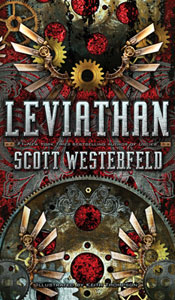
LEVIATHAN by Scott Westerfeld, (Simon Pulse, 2009).
GENRE: Adventure - Steampunk / Alt. History
AGE: 12 and up
Scott Westerfeld's Leviathan, the first book in a planned trilogy, is the sort of old-fashioned adventure novel that you don't see much of anymore. It's the sort of book that would have shared shelf-space with Treasure Island and The Time Machine if it were written 100 years ago, which it couldn't have been, even if Orwell could have conceived of genetic mutations and gene splicing. This is mostly because, for all its harkening back to the days of the "boy's adventure story," Westerfeld's Leviathan is the product of a modern phenomena - the mashed-up landscape of alt. history in all it's steam-powered glory.
The book starts on the night of Archduke Franz Ferdinand's assassination, an event that plunged Europe into the First World War. The Archduke's son, Prince Aleksander, flees for the Swiss border with a handful of trusted retainers in a Cyklops Stormwalker, as massive, humanoid war machine. With that, Westerfeld plunges the reader into an alternative world, one where WWI is fought between Clankers (nations with advanced mechanized technology) and the Darwinists (England and it's allies, who create new species based on Darwin's principles).
Westerfeld develops both sides through alternating chapters. While Alek learns to pilot the Stormwalker and dodge hostile troops, a young woman named Daryn Sharp disguises herself as a boy and joins the British Air Service. Through sheer accident, (her cephalopodic jellyfish - you really just need to read the book - gets caught in a storm), she's rescued by the Leviathan, a massive, living, hydrogen-based airship. As events on the world stage grow tense, the Stormtrooper and the Leviathan make their way to Switzerland, where Alek's Clankers and the Deryn's Darwinists finally meet.
Before you know it, you're fully engaged in the Leviathan's secret mission to Constantinople and the question of how Alek will survive the war without getting assassinated. It's Westerfeld's mastery of real history that makes his alternative history so seemlessly compelling. There is nothing inauthentic about the tension between the Clankers and the Darwinists. The fabric of cultural antipathy is woven so tightly that you never question the possibility of the mechanical and genetic advances that define each society.
And it isn't just the world that fascinates. Deryn and Alek are honestly interesting. Though they both fit certain archetypes, there is nothing of the stock character about either of them. Both are nuanced individuals who grow as a result of the rather extraordinary circumstances they find themselves in. The supporting characters are equally fun, particularly Wildcount Volger, the mastermind behind Alek's escape, and Dr. Nora Barlow, a female "boffin" or genetic engineer who tartly takes all manner of things into her own hands.These adults are quirky, flawed and capable. They leave the young protagonists ample room to move and plenty of agency without descending into the stereotypical uselessness of so many adults in book for teens.
To make a long story short - too late, I know - Leviathan is a shockingly fun read. Get past the first several chapters and you're off. Even without the maps and illustrations (which are jolly good fun), it's nearly impossible not to get sucked into Westerfeld's WWI. Entirely engaging and oddly educational, Leviathan is classic in the best sense of the word.
Showing posts with label adventure. Show all posts
October 26, 2012
August 20, 2012
The Adventures of Sir Balin the Ill-Fated
THE ADVENTURES OF SIR BALIN THE ILL-FATED by Gerald Morris; Illustrated by Aaron Renier, (Houghton Mifflin, 2012)
Oh Sir Balin, you carry the heavy weight of destiny upon your noble shoulders. But can and should you trust the Old Woman of the Indeterminate Mountain's prophecy, especially when the Prophetess Guild's standards have been flagging of late? How much of destiny is predetermined? How much of your fate is really yours to control?
Gerald Morris, Arthurian scholar and author of The Squire's Tale series for younger readers, peppers his newest installment of the popular Knight's Tale series, The Adventures of Sir Balin the Ill-Fated, with these questions, but never to the detriment of good, irreverent fun. When an old woman makes a prophesy over Balin's cradle that he will become known as the noblest knight in the land, but that misfortune will follow in his wake, it colors his future, so much so that the prophecy becomes self-fulfilling. Then Annalise, The Questing Lady, and Balin's older brother, Sir Balan (their mother wanted a matched set), help Sir Balin see past the seemingly air-tight pattern of unfortunate events that comprise his knighthood to the possibility that his destiny is his to make.
Though the tale of Sir Balin has its roots traditional Arthurian tales, Morris's irreverent voice and colloquial dialogue bring the story galloping into the 21st century. With details that would be at home in a Monty Python sketch (there's a bit where various knights suggest ways of releasing a magical sword from it's scabbard - jiggling the hilt and bacon grease figure in), the general tone of silly fun is an excellent balance for Morris's age-appropriate ruminations on the nature of fate. Additionally leavened by Aaron Renier's clobberingly comedic illustrations, The Adventures of Sir Balin the Ill-Fated is a quick read and a serious, but not too serious, winner.
AGE: 9 and up
Oh Sir Balin, you carry the heavy weight of destiny upon your noble shoulders. But can and should you trust the Old Woman of the Indeterminate Mountain's prophecy, especially when the Prophetess Guild's standards have been flagging of late? How much of destiny is predetermined? How much of your fate is really yours to control?
Gerald Morris, Arthurian scholar and author of The Squire's Tale series for younger readers, peppers his newest installment of the popular Knight's Tale series, The Adventures of Sir Balin the Ill-Fated, with these questions, but never to the detriment of good, irreverent fun. When an old woman makes a prophesy over Balin's cradle that he will become known as the noblest knight in the land, but that misfortune will follow in his wake, it colors his future, so much so that the prophecy becomes self-fulfilling. Then Annalise, The Questing Lady, and Balin's older brother, Sir Balan (their mother wanted a matched set), help Sir Balin see past the seemingly air-tight pattern of unfortunate events that comprise his knighthood to the possibility that his destiny is his to make.
Though the tale of Sir Balin has its roots traditional Arthurian tales, Morris's irreverent voice and colloquial dialogue bring the story galloping into the 21st century. With details that would be at home in a Monty Python sketch (there's a bit where various knights suggest ways of releasing a magical sword from it's scabbard - jiggling the hilt and bacon grease figure in), the general tone of silly fun is an excellent balance for Morris's age-appropriate ruminations on the nature of fate. Additionally leavened by Aaron Renier's clobberingly comedic illustrations, The Adventures of Sir Balin the Ill-Fated is a quick read and a serious, but not too serious, winner.
August 9, 2012
The Dark is Rising
THE DARK IS RISING by Susan Cooper (Scholastic, 1974)GENRE: Fantasy
HONORS: Newbery Honor (1974)
REVIEW: On his eleventh birthday, Will Stanton, the seventh son of a seventh son, finds out that he is an Old One, an ancient race of beings who keep the Dark at bay in the name of the Light. No sooner does Will discover that his true purpose as the Seeker, the Old One destined to unite the Things of Power, than he is plunged into the battle between Light and Dark, Good and Evil. The story follows Will as he collects the Six Signs to form the Circle, pursued by the Black Rider, an agent of Darkness, and added by Merriman Lyon, The Lady and other Old Ones who have been fighting the Dark for centuries. Peppered with elements from Celtic myth and Arthurian legend, The Dark is Rising (the second in The Dark is Rising Sequence) is a layered and thoughtful combination of old myth, fantasy and contemporary suspense. It is a book that rewards focus and attention, even while giving it's readers an entertaining, satisfying ride.
OPINION: Beautifully written and briskly paced, The Dark is Rising, smacks of literary quality even as its premise is rooted firmly in the fantasy tradition. Will is a compelling hero - mature, smart, savvy and slightly flawed. He is a kid that most readers would want to be, or at least be friends with. His growth over the course of the novel, spurred primarily through his expanding view of the world, is one that many young readers will identify with, even if they themselves are unlikely to battle the Dark or call on the Wild Hunt for assistance. A tween fantasy classic for a reason, it is arguably the strongest title in The Dark is Rising Sequence, one that stands firmly on it's own.
IDEAS: A wonderful tie in to units on world mythology, particularly Celtic mythology and Arthurian legend. Also a good way to introduce theme, symbolism and allusion. A great recommendation to kids who need to read a Newbery book, but who are more interested in genre fiction than realism. This book has stood the test of time and still feels urgent and contemporary.
August 3, 2012
Lilly and the Pirates
LILLY AND THE PIRATES by Phyllis Root; Illustrated by Rob Shepperson (Boyds Mills Press, 2010)
GENRE: Adventure
HONORS: None
REVIEW: Lilly worries. She worries a lot. What if a yodeler causes an avalanche? What if her parents get swept out to sea? She worries to keep disaster at bay, writing down her concerns in her worry book and hoping for the best - until her scientist parents go on an expedition to the Shipwreck Islands to study the frangipani fruit fly, leaving Lilly behind. When their boat wrecks on the reefs, it is up to Lilly to rescue them by overcoming her fear of the sea and finding the hidden island, all while outsmarting a bunch of pirates. She even learns not to worry - at least, not quite so much. Root's lean, well-paced chapter book is exciting and gently silly (the scholar pirate swears by shouting E=MC2!), while Lilly herself is an honest of an anxious child. Her preventative worrying will be familiar to any young worrier, and though slightly over the top, Root treats her with understanding and respect, all while allowing Lilly to overcome her worries in situationally appropriate, intuitive ways. Encouraging without being preachy, Lilly and the Pirates is a hidden gem - a real buried treasure!
OPINION: Lilly and the Pirates is a quick and extremely charming read. Easy to overlook (it deals with classic themes in classic ways), it still manages to feel fresh and modern. Shepperson's illustrations are great (especially the one of Lilly underwater, debating whether or not to let her worry book go so she can float to the surface), lending Root's tale an air of jaunty, piratical fun. Though it may require some blatant pushing at first, it's popularity is likely to grow through sheer word of mouth.
IDEAS: An unexpected though excellent addition to a pirate, adventure or even humor display. Even more directly, however, it's a wonderful recommendation for kids prone to worry or anxiety who are looking for a genuinely fun and encouraging adventure. In addition, it's a great book for younger adolescents or even grade school kids to read with their parents - especially given the lovely relationship between Lilly and her parents paired with her ability to strike out on her own independently at the end of the book while still loving them.
August 2, 2012
The Book of Time
THE BOOK OF TIME by Guillaume Prevost (Scholastic, 2006)
GENRE: Science Fiction - Time Travel
HONORS: None
REVIEW: Sam Faulkner, 14, has had a difficult couple of years. After his mother died, his father, Allan, sold their house and opened an antique bookstore in a run-down house. Just when things start to become normal again, Allan disappears. But when Sam goes to look for him, he finds a stone in the basement that enables him to time travel - to a monastery under Viking attack, to a French battlefield in WWI and a temple in Ancient Egypt. The more Sam travels, the more he understands, until, with the help of his cousin, he deduces that his father is being held captive by Vlad Tepes in 15th century Translyvania. Unforunately, that's when the book ends. Though fast-paced and terrifically interesting, most of The Book of Time reads as if the author is simply laying groundwork for the next book, an impression confirmed by the abrupt cliff-hanger ending. This is unfortunate because the story is well-paced with a genuinely likable protagonist and tons of interesting, accessible historical material. For all that, it fails to work as a cohesive whole - in trying to establish a narrative arc for the series, the author failed to establish an arc for the book.
OPINION: For all it's structural flaws, The Book of Time is still a worthwhile read. The pacing is great - the author hardly allows Sam, or the reader, time to take a breath before launching into a new dangers. Even Sam's present day is full of threatening bullies and his aunt's suspicious new boyfriend. With this much adventure, action and suspense, (not to mention the highest of stakes - his father is being held captive by Vlad the Impaler), The Book of Time is likely to please.
IDEAS: This is fun, accessible science-fiction for kids who don't like science fiction. It's also a fantastic book for classroom use as Prevost (who teaches history) lines each adventure with serious doses of historical interest and detail. The Scholastic edition also includes a comprehensive list of discussion questions, making it a truly educational volume, even though it feels like nothing more than fun when you're reading it.
July 31, 2012
The Girl Who Circumnavigated Fairyland in a Ship of Her Own Making
THE GIRL WHO CIRCUMNAVIGATED FAIRYLAND IN A SHIP OF HER OWN MAKING by Catherynne M. Valente; Illustrated by Ana Juan (Square Fish, 2012)
GENRE: Fantasy / Fairytale
HONORS: Andre Norton Award
REVIEW: While washing pink and yellow teacups in her kitchen sink, September is offered the chance to ride the Leopard of Gentle Breezes to Fairyland with the Green Wind, a natty and mischievous individual. September, who is not only tired of washing teacups, but of Nebraska and of normal life in general, accepts, embarking on an adventure that takes her to Pandemonium, (the capital of Fairyland) and the home of the evil Marquess, to the Autumn territories where it is always Halloween, around the whole of Fairyland in her titular ship and finally to the Lonely Jail, where all is explained. Along the way, she meets a girl made of soap, a Wyverary (a Wyvern that is half library), witches, pookahs, alchemists, velocipedes, a boy named Saturday and her own Death. While drawing liberally on motifs and themes from multiple fairy tales, Valente manages to construct a story that is both linguistically beautiful and completely unique. September's journey lands her in unexpected and oddly familiar places, while the climax, though (in hindsight) is perfectly, constructed and inevitable, still manages to surprise. A gorgeous and truly special book, The Girl Who Circumnavigated Fairyland in a Ship of Her Own Making is a lovely, jewel of a thing, full of enough adventure and emotional resonance to have readers gobbling it up like fairy food.
OPINION: This is, so far, my favorite book of the semester. Valente's narrative voice is playful and sure, drawsing on old-fashioned language and conceits (such as asides to the reader) that in her hands feels fresh and new. Everything about September's story vibrates with energy and color, but what makes it stand out, particularly, is the emotional depth operating beneath the visual and linguistic loveliness. Themes of loneliness, fear and regret play out gracefully to the end, making The Girl Who Circumnavigated Fairyland in a Ship of Her Own Making much more than just a charming face.
IDEAS: A good suggestion for slightly older tweens with the ability to focus on language. While not a difficult read, it does require a bit of focus and maturity from the reader. It would be especially fun for tweens who enjoy fairy tales and classics like Alice's Adventures in Wonderland as Valente refers to many of them thematically and stylistically throughout. Also a wonderful choice for a library or school book club, where an adult could help lead discussions on any number of possible topics.
The Mummy's Mother
THE MUMMY'S MOTHER by Tony Johnston (Blue Sky Press, 2003)
GENRE: Adventure / Humor
HONORS: None
REVIEW: Ramoses is a 4, 010 year old mummy (4, 010 because he was 10 years old when he was mummified 4,000 years ago). For all that time, he and his mother, the Queen, have been tucked quietly in their tomb, waiting for the Afterlife, until one day, nefarious thieves steal his mother's mummy away. Though young, inexperienced and a bit physically fragile (one good thump could crumble his ancient bones), Ramoses heads off in pursuit, undertaking a journey that leads him through the desert on a cranky camel, to a ship where he makes friends and plays ping-pong and finally to New York, where his mother is being displayed in a museum. Ramoses is a sweet and earnest protagonist, whose vulnerabilities (both emotional and physical) are nicely balanced by his bravery and his ability to rise to every occasion. Johnston keeps things moving without unduly rushing the narrative. The result is a well-paced little story that lingers just long enough on each of Ramoses's adventures for humor or tension to bloom, without interfering with the pace.
OPINION: The Mummy's Mother makes up in humor and pacing for what it lacks in depth. Still, given that it is aimed at younger adolescents, a slight lack of depth could be considered a plus. It is especially humorous that Ramoses, who looks like a typical mummy, never arouses the suspicion of adults, most of whom assume he is a normal boy wearing bandages for some reason. This fun and funny suspension of disbelief contributes greatly to the book's charm. As an added benefit, Johnston weaves in a lot of aspects of Ancient Egyptian history and mythology, which will likely pique the interest of young readers and perhaps prompt them to learn more.
IDEAS: A great suggestion to younger tweens interested in Ancient Egypt or quick adventures with a gentle dose of humor. Also a nice supplementary reading for classrooms who are doing a unit on world mythology as the names and functions of Egyptian gods are featured throughout.
July 27, 2012
From the Mixed-Up Files of Mrs. Basil E. Frankweiler
FROM THE MIXED-UP FILES OF MRS. BASIL E. FRANKWEILER by E.L. Konigsburg (Aladdin, 2002)
GENRE: Contemporary
HONORS: Newbery Medal
REVIEW: When 11-year-old Claudia Kincaid decides to leave home, she decides to do so in comfort, so she invites her 9-year-old brother Jamie, (who has saved all his money), to come with her. The two Kincaids follow Claudia's plan not to run away from home, but rather to run to The Metropolitan Museum of Art. Jamie and Claudia take up residence at the museum, hiding in bathrooms and sleeping in antique beds, while displaying a level of intelligence and discipline that is admirable in kids their age. What follows is an adventure that, though quiet by 21st century standards, feels both true and engaging. Claudia and Jamie balance each other, for while Claudia is the planner, Jamie holds the purse-strings, resulting in a dynamic that is one of equals. The mystery of the angel statue, (which leads them to Mrs. Frankweiler's mixed-up files), keeps the narrative moving and gives Claudia and Jamie greater purpose. The result is an engrossing, quick read in which Claudia and Jamie gain a greater understanding of themselves and each other, in addition to discovering the statue's mysterious origins.
OPINION: From the Mixed-Up Files of Mrs. Basil E. Frankweiler has become a modern classic for a reason. Claudia and Jamie are fantastic, complicated characters. They are both flawed, but also remarkable in their ways, making them excellent role-models. Their relationship with each other - one of grudging respect and even admiration - is complex, requiring the reader to think beyond simple, stock brother / sister dynamics. Konisberg keeps the narrative calm, but taut - she has incredible control over her pacing and plot. It really is a must-read.
IDEAS: This is a book that respects it's reader. It's a great introduction to literary mysteries. Also wonderful for kids interested in New York, or those that need to read a Newbery book, but can't find one that interests them. Also a nice addition to a display for books on museums, adventures, art or mysteries. Fantastic book to discuss in class, as well.
July 10, 2012
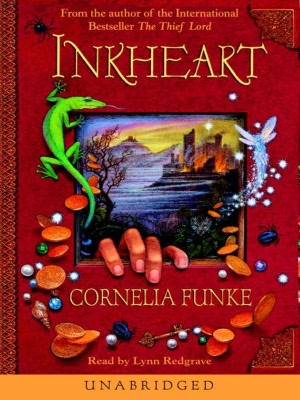
Inkheart
INKHEART by Cornelia Funke; Read by Lynn Redgrave. (Learning Library Audio, 2005)
GENRE: Adventure / Audiobook
HONORS: None
REVIEW: Inkheart is the story of a girl, Meggie, her bookbinder father, Mo, and the trouble that lands on their doorstep when a figure from Mo's past arrives one rainy night. Though exquisitely detailed with adventures and secrets and nefarious doings and hard-won triumphs, Inkheart is, in the end, a love note to books. Meggie is a born reader with a reverence for the printed page that she inherited (along with a slightly more dangerous gift) from her father. Solace and comfort are found between the pages of various stories, which is interesting because the novel's greatest villain also springs forth from the written word. Though overlong at times, (the book sometimes stalls under the weight of Funke's admittedly beautiful descriptions), Inkheart is a pleasure - truly engrossing, charmingly adventurous and satsifyingly resolved. The audiobook also has the advantage of being read by Lynn Redgrave whose vocal performance is nuanced, varied and masterful. Somehow she manages to sound equally convincing as an illiterate thug as she does as a twelve-year old girl. A real treat.
OPINION: The novel is tailor made for younger tweens hungering for an "epic" series to try. Though the action is dark at times, and genuinely a bit frightening, the story follows many of the tropes established in the books that Meggie so loves. In this way, Inkheart is oddly comforting, even as it keeps you on your toes.
IDEAS: A wonderful suggestion for reluctant readers, boys and girls alike. Also a great pick for a tween book club, especially if the members tend towards the younger side.
Pendragon Book One: The Merchant of Death
PENDRAGON Graphic Novel Book One: THE MERCHANT OF DEATH by Carla Speed McNeal. Based on the novel by D.J. MacHale (Aladdin, 2008).
GENRE: Graphic Novel / Adventure
HONORS: None
REVIEW: Bobby Pendragon is an enviable kid. He's popular, good at sports and romantically linked to a really great girl. But he's also what's known as a "traveler"- people who travel between worlds through "flumes" or passages in time and space. Travelers move between dimensions righting wrongs and doing good, ultimately battling the Traveler-gone-wrong, Saint Dane, the series' big villain. It's a very appealing premise, one with a lot of fantastic potential. Unfortunately, that potential remains unmet, at least in this graphic novel adaptation. Bobby is a singularly unappealing protagonist - weak, vain and shallow - and, unfortunately, there is little growth shown over the course of the narrative arc. One gets the sense that, as Bobby accepts his new, inter-dimensional role, he will only become a different shade of insufferable. The story itself is a storehouse of recyled tropes - boy discovers true identity and gets dragged into a "fight that isn't his", adult role models hang around just long enough to get captured or killed before the apprenticeship is over, and there's even an arena fight. A decent adventure, but nothing to write home about.
OPINION: There's nothing wrong, exactly, with this story. It simply rings shallow and predictable. McNeal's illustrations, though competent, are relatively generic, often tending towards the cluttered and unclear, while the slang incorporated to appeal to tweens ("coolio", "lou-zah!" etc.) rings false and forced. An overall middle-of-the-road offering that will probably appeal to younger male tweens, but make no lasting impression.
IDEAS: A fun supplement to the book series, it's a good introduction to the novels for reluctant readers (especially boys) intimidated by the longer form.
July 9, 2012
Percy Jackson and the Olympians: The Lighting Thief
PERCY JACKSON & THE OLYMPIANS:
THE LIGHTENING THIEF. Film adaptation. (Directed by Chris Columbus. Starring
Logan Lerhman. Based on the novels by Rick Riorden)
GENRE: Action / Adventure
HONORS: None
REVIEW: The film adaptation of
Rick Riorden’s best-selling series, Percy Jackson and the Olympians, moves at an efficient pace while maintaining the essence
of what makes the books so appealing – Percy’s struggle to manage himself in
the wider world. Lehrman plays Percy, demigod and son of Poseiden, with modern
flair, mixing enough defiance into Percy’s geekiness to make him an appealing
underdog with plenty of fight. Grover, his satyr "protector", grounds
Percy’s quest in contextual gravity while providing comic relief, while
Annabeth, the battle-ready daughter of Athena is a nice foil for Percy, who is
literally dropped into his new reality when a Fury accosts him. Upon learning
of his true heritage, Percy rises to the challenge and proves himself to be a
natural hero with what seems to be, at times, convenient ease.
OPINION: The emotional core of Percy
Jackson and the Lightening Thief rang
hollow at times and it lacks the world-building creativity of other series
adaptations, but it is still a satisfying ride that will no doubt appeal to
fans of the books.
IDEAS: A strong addition to any
unit on Greek mythology or hero quests. Show the film and talk about parallels
between Percy’s quest and the mythological quests it draws from (Odysseus and
the lotus-eaters, Perseus and Medusa, Orpheus in Hades, etc.). There is also an
inherent appeal for kids with dyslexia and ADHD as Percy struggles with these
conditions before discovering that he is a hero.
July 6, 2012
The Mysterious Benedict Society
GENRE: Mystery
HONORS: New York Times
Notable Children’s Book; Booklist Editors’ Choice
REVIEW: The Mysterious Benedict Society
is the longish story of four extraordinary misfits who take on evil and
challenge themselves in the process. It's a charming book in some ways, and
Trenton Lee Stewart certainly knows how to work the conventions (misfit finds
other misfits to fit in with, children solving problems no adult can, orphans
finding some form of family etc) . That said, I was disappointed. Even though The
Mysterious Benedict Society does pretty
much everything right, the results are pretty lackluster.
OPINION: While the novel is
technically good, it lacks soul, or more specifically, it lacks an
understanding of a child's soul. All of Stewart's extraordinary kids - from
Reynie Muldoon, the moral compass and natural leader, to George
"Sticky" Washington, the genius beset by nervous ticks - feel like an
adult's "Very Clever" conception of very clever kids. There's a fug
of grown-upness over the whole thing that reads as subtly disingenuous. The
other problem is that there’s a huge build-up to what should be a huge
show-down, but the final resolution happens off-screen, and it's not even the
kids who achieve it. Then, because of serious authorial strong-arming, everyone
ends up happy. There's too much machination, and too little imagination.
Ultimately, the story fails to meet its own potential.
IDEAS: Despite my reservations, The
Mysterious Benedict Society and its
sequels have become best sellers, proving their popularity with young readers.
With the amount of puzzle solving and problem-tackling embedded in the story,
it’s a good way to introduce the power of logic and independent thought to
younger tweens.
Subscribe to:
Posts (Atom)