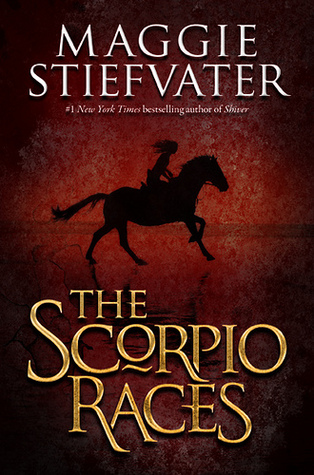
THE SCORPIO RACES by Maggie Stiefvater (Scholastic Press, 2011)
GENRE: Fantastic Realism / Romance
AGE: 14 and up
Though not without issues, The Scorpio Races is an excellent book. It has countless starred reviews and a Printz Honor to prove it, and though it takes more than that to convince me of anything, I agree that, for the most part, it lives up to the hype - the plotting is solid, the language is lovely and the setting is moody and atmospheric. That said, I'd like to leave all that aside and look at the two elements that gave this book a quality rare in mainstream YA lit. The first is the seamless integration, in the form of the water horses, of the fantastic into a story that is otherwise rooted staunchly in reality. The other is the subtlety of the Stiefvater's characterizations, particularly with Sean Kendrick. But a little summary first:
Every October, the capaill uische, mythical and predatory water horses, come up out of the water onto the fictional island of Thisby. Their arrival culminates, on November 1st, with the Scorpio Races, a day of bloody racing where the men of the island ride the capaill uische across the beach, some to glory, many to death. Sean Kendrick has won the Scorpio Races four years out of six, and is respected on the island, despite his silence and stillness, thanks to his uncanny way with horses, both mundane and magical. Kate, aka Puck, Connelly, has never had use for the races and has always steered clear of capaill uische, particularly since her parents died the year before. But when her older brother announces that he's moving to the mainland, Kate decides to ride in the races, not for honor, but for the winners purse. But as Nov. 1st gets closer, the stakes get higher for both Puck and Sean until the day of the race when their fates are decided on the bloody beach.
The capaill uische legend has a lot of variants. Based on the source materials, this could easily have become just another romance about a girl who falls in love with a shapeshifting beast. But Stiefvater takes a more nuanced approach. The Isle of Thisby is a windblown, rocky place with it's roots deep in the past. It has little need for the present. It is losing it's young people to mainland, its only real economies are fishing and tourism and there are scant opportunities for work, (issues that reflect the current reality of many small towns). Stiefvater layers the magical water horses into this reality without explanation or excuse, and the technique works. By defying the temptation to myth-make, Stiefvater grounds the story, keeping the focus on her characters' determination to transcend the limitations of their situations. Though the romance is a key element, the narrative isn't about the relationship that grows between Sean and Puck. It is much more about Sean and Puck coming into their own. They simply find each other in the process.
The other element that works particularly well is Sean's character development. Puck is plucky and emotionally true, but she is of a recognizable type (feisty red-head with plenty of guff) whereas I've never seen a character quite like Sean. He's nineteen, but an old nineteen, with a stillness and perspective that, while impressive, reads as natural to his character. His chapters (the story is told with alternating POV) contain some of the loveliest, most incisive observations I've read in a while. His arc is a subtle one and watching him rock and re-center on his foundation was a quiet pleasure.
While younger readers will enjoy the horsey elements of the book, and the romance is fairly tame and tween approved, I would say that Puck and Sean go places that older teens will identify with more readily. Though the pacing is somewhat sluggish (all those lovely descriptive elements occasionally bog down the plot), The Scorpio Races is a beautiful read, subtle in ways that are rare in YA fiction. It really is a winner - especially if you happen to like horses, and even if you don't.
Showing posts with label fantasy. Show all posts
October 11, 2012
September 26, 2012
Daughter of Smoke and Bone
Daughter of Smoke and Bone by Laini Taylor, (Little Brown, 2011).
GENRE: Urban Fantasy
AGE: 15 and up
In a literary landscape glutted with star-crossed romance, Laini Taylor's Daughter of Smoke and Bone, stands out as something unique, a work so far ahead of its contemporaries that it renders comparisons unfair.
Though the novel opens in contemporary Prague, it spans two worlds - our own and Eretz, a parallel place destroyed by ancient wars, which can only be accessed through magical portals and slits in the sky. With no memory of her parents, Karou, Taylor's beautiful, blue-haired protagonist, is raised in a space between Earth and Eretz by Brimstone, a chimaera (mythical creatures that are half-human and half-animal) and his assistants. She lives two half-lives - one as an art student in Prague, the other as Brimstone's courier, until the portals to his shop are destroyed and Karou is cast out. Bent on returning, Karou confronts Akiva, one of the seraphs responsible for the destruction of the doorways, and unknowingly begins the process of rediscovering who she is.
There is so much more to this novel than summarization can sufficiently communicate. Karou is a highly nuanced heroine, a seventeen year old with piques and pettiness as well as a deep reserve of strength and the feral will to survive. She is the embodiment of agency and the places Taylor takes her are worthy of her complexity. The novel's secondary characters match Karou's full-bloodedness. Brimstone, Zusana, Karou's tiny, crackling best-friend, Akiva, and even Kaz, her ridiculous ex - all are exceptionally recognizable as people, not constructs, in their way.
Taylor's sense of aesthetics (Zusana's giant marionette, Karou's lapis hair), her facility with imagery, (black handprints on the portal doors, the caged city), and instinct with physical characterization (a baby Karou playing w/ brimstone's tail, the anxious flutter of a chimaera's bat wings) create a landscape so light and lush, so simply gorgeous that it feels like the print equivalent of Karou's sketchbooks, but what makes the book special is the substance beneath the aesthetics. There's a perceptive depth to Karou's isolation that is just not describable. It's what makes Taylor such a writer to envy - the nebulous strength of her work is layered throughout every aspect of the book, impossible to tease out.
This is a challenging, engaging novel and though it is driven by a romance (as are so many YA novels), the romance has unexpected elements and is stricken by very real difficulties. It will no doubt resonate with older teens readers who have, perhaps, already tasted their first heartbreaks. Taylor does not pander to her reader. She writes to the fullness of the concept's potential, which is really quite high. An exquisite, perfectly paced pleasure.
August 28, 2012
Teeth: Vampire Tales
TEETH: Vampire Tales edited by Ellen Datlow and Terri Windling, (Harper, 2011)
GENRE: Short Stories / Vampires in Multiple Genres
As with all of their anthologies, Ellen Datlow and Terri Windling have put together a formidable collection, this time on the now ubiquitous subject of... Vampires. What more could there be to say, one might ask? Windlow and Datlow answer this question with a surprisingly scholarly, yet undeniably compelling "well, quite a lot".
The collection's introduction is written in Datlow and Windling's trademark voice - earnest, accessible, in touch - and yet, they concisely cover the multi-cultural history of vampire literature in a matter of pages, giving the reader (whom both the editors and authors do not coddle) the background needed to fully appreciate the layered aspects of the stories that follow. That said, some of the stories, though beautifully written, lack a certain bite (please forgive the pun). Elegant though it is, Tanith Lee's "Why Light? " trods well-trodden ground, while Ellen Kushner's "History" takes a potentially interesting premise down a disappointing, anticlimactic road. That said, there are gems of inventive beauty in here too - most notably Catherynne M. Valente's "In the Future When All's Well", a 1st person account of life after humans begin to spontaneously turn (the language, characterization and society are subtly addictive), while the collaborative efforts of Holly Black and Cassandra Clare make "The Perfect Dinner Party" by turns hilarious, shocking and grim as they take the child vampire trope to an entirely new place.
These two stories alone are worth the price of the collection, though none of the tales disappoint. With substance, intelligence and snap, these stories ask the reader to look beyond tortured anti-heroes and the mortal women who love them, and to once again consider the real strength of the vampire in literature as a metaphor for the moral tangle of ourselves and our society.
August 25, 2012
Clockwork Angel
CLOCKWORK ANGEL: The Infernal Devices Trilogy, Book 1 by Cassandra Clare, (Simon & Schuster, 2010)
GENRE: Paranormal Romance / Historical Fantasy
AGE: 14 and up
Tessa Gray's arrival in England is portentously unsettling. Met not by her brother, Nate, but by his self-proclaimed landladies, two women calling themselves the "Dark Sisters," Tessa is swept away and held prisoner for nearly two months. In that time, the Sisters unlock an ability in Tessa that she hadn't known she had - the ability to literally become someone else. Plunged into the Shadow World, a realm of faeries and warlocks, vampires and werewolves, overseen by the Nephelim, (angel descended warriors called Shadowhunters), Tessa struggles to master her unsettling ability and find her missing brother. When a young Shadowhunter named Will Herendale rescues Tessa, she becomes the key to discovering the identity of The Magister, the mastermind behind a plot to topple the order imposed by the Nephilim, a role the bookish, practical Tessa must learn to embrace.
Clockwork Angel is a compellingly atmospheric book. Tessa's dogged search for her brother, Nate, drives various subplots while providing momentum and color to the overall arc. The tone is pleasantly gothic with plenty of sinister houses and fog shrouded London streets, the perfect backdrop for a clockwork army and a demonic mastermind. Though the characters are somewhat idealized - the handsome, self-destructive Will who harbors a dark secret beneath a sardonic grin; beautiful, silver-haired Jem whose compassion and perspective exceed his seventeen years; and Tessa, whose earnest authenticity is balanced with a seriousness that makes her a surprisingly practical heroine - all three protagonists are oddly likable characters with flashes of real emotional resonance, though I do wish that Tessa's ability had played a more active, (and less theoretical role) in the events of the book as they unfold. The romantic aspects of the novel are age-appropriately steamy (several searing kisses and many a longing glance), while never threatening to derail the rest of the plot. Even still, the tension between Tessa and Will adds a great deal to the overall tension of the narrative arc.
Clockwork Angel is the first in a trilogy set in the same world as Clare's Mortal Instruments series. The dishy Victorian setting adds a nice bit of background to the happenings in that series, while ensuring that this new trilogy stands on its own. Despite lagging a bit towards the end (too much denouement) and fight scenes that beggar belief at times (death by parasol commonly occurs), Clockwork Angel is a well-written, tremendously enjoyable read and a great introduction to what will certainly be a popular new series.
August 20, 2012
The Adventures of Sir Balin the Ill-Fated
THE ADVENTURES OF SIR BALIN THE ILL-FATED by Gerald Morris; Illustrated by Aaron Renier, (Houghton Mifflin, 2012)
Oh Sir Balin, you carry the heavy weight of destiny upon your noble shoulders. But can and should you trust the Old Woman of the Indeterminate Mountain's prophecy, especially when the Prophetess Guild's standards have been flagging of late? How much of destiny is predetermined? How much of your fate is really yours to control?
Gerald Morris, Arthurian scholar and author of The Squire's Tale series for younger readers, peppers his newest installment of the popular Knight's Tale series, The Adventures of Sir Balin the Ill-Fated, with these questions, but never to the detriment of good, irreverent fun. When an old woman makes a prophesy over Balin's cradle that he will become known as the noblest knight in the land, but that misfortune will follow in his wake, it colors his future, so much so that the prophecy becomes self-fulfilling. Then Annalise, The Questing Lady, and Balin's older brother, Sir Balan (their mother wanted a matched set), help Sir Balin see past the seemingly air-tight pattern of unfortunate events that comprise his knighthood to the possibility that his destiny is his to make.
Though the tale of Sir Balin has its roots traditional Arthurian tales, Morris's irreverent voice and colloquial dialogue bring the story galloping into the 21st century. With details that would be at home in a Monty Python sketch (there's a bit where various knights suggest ways of releasing a magical sword from it's scabbard - jiggling the hilt and bacon grease figure in), the general tone of silly fun is an excellent balance for Morris's age-appropriate ruminations on the nature of fate. Additionally leavened by Aaron Renier's clobberingly comedic illustrations, The Adventures of Sir Balin the Ill-Fated is a quick read and a serious, but not too serious, winner.
AGE: 9 and up
Oh Sir Balin, you carry the heavy weight of destiny upon your noble shoulders. But can and should you trust the Old Woman of the Indeterminate Mountain's prophecy, especially when the Prophetess Guild's standards have been flagging of late? How much of destiny is predetermined? How much of your fate is really yours to control?
Gerald Morris, Arthurian scholar and author of The Squire's Tale series for younger readers, peppers his newest installment of the popular Knight's Tale series, The Adventures of Sir Balin the Ill-Fated, with these questions, but never to the detriment of good, irreverent fun. When an old woman makes a prophesy over Balin's cradle that he will become known as the noblest knight in the land, but that misfortune will follow in his wake, it colors his future, so much so that the prophecy becomes self-fulfilling. Then Annalise, The Questing Lady, and Balin's older brother, Sir Balan (their mother wanted a matched set), help Sir Balin see past the seemingly air-tight pattern of unfortunate events that comprise his knighthood to the possibility that his destiny is his to make.
Though the tale of Sir Balin has its roots traditional Arthurian tales, Morris's irreverent voice and colloquial dialogue bring the story galloping into the 21st century. With details that would be at home in a Monty Python sketch (there's a bit where various knights suggest ways of releasing a magical sword from it's scabbard - jiggling the hilt and bacon grease figure in), the general tone of silly fun is an excellent balance for Morris's age-appropriate ruminations on the nature of fate. Additionally leavened by Aaron Renier's clobberingly comedic illustrations, The Adventures of Sir Balin the Ill-Fated is a quick read and a serious, but not too serious, winner.
August 13, 2012
Bella at Midnight
BELLA AT MIDNIGHT by Diane Stanley (Harper Collins, 2006)
GENRE: Historical Romance - Fairy Tale
AGE: 10 and up
Firmly constructed on Cinderella's framework, Diane Stanley nevertheless manages to bring a fresh approach to the classic tale with her novel, Bella at Midnight. In this version, the heroine, Bella, though a knight's daughter, is fostered to a family of peasants, who lovingly raise her until her thirteenth year. When her father recalls her home, she is little prepared for her new life as a lady and the coldness of her father's home. However, Bella is kind and spirited. When she learns of a plot that threatens Prince Julian, her childhood friend, she embarks on a quest to save him aided only by her godmother, an enchanted ring and a pair of lovely glass slippers. Bella's success in the endeavor, however, has less to do with magical objects, and everything to do with the strength of her character.
Stanley's take on this familiar tale is distinctly historical in nature. Although the two warring countries are fictional, they bear great similarities to standard, medieval European societies, and though magic is not completely absent from the plot (the enchanted ring does reassure at critical moments), enchantments are, for the most part, underplayed. Stanley's narrative structure is one of alternating viewpoints, and though Bella receives more chapters than any other character, her point of view is most certainly not the only one (Prince Julian, her godmother, her foster mother and even her resentful, ill-treated stepmother and mute stepsister receive chapters of their own). For the most part, this convention works, lending the novel as scope that it otherwise would not have. Unfortunately, it also suffers from muted tensions and dulled focus because of it (nearly 80 pages are told from the stepmother's and stepsisters' points of view, lending them an excellent, interesting backstory but diluting the main thrust of the plot). That said, Stanley navigates her material deliberately, giving the reader a climax that elegantly ties up loose ends. The romance, though sweet, is underdeveloped and slightly tepid, though these very qualities make it appropriate for tweens not yet prepared for more intense relationships. Overall, it is an interesting alternative to more traditional Cinderellas, one that I wouldn't hesitate to recommend for it's discussion value alone.
Labels:
fairy tale,
fantasy,
historical,
romance,
tween,
YA
August 9, 2012
The Dark is Rising
THE DARK IS RISING by Susan Cooper (Scholastic, 1974)GENRE: Fantasy
HONORS: Newbery Honor (1974)
REVIEW: On his eleventh birthday, Will Stanton, the seventh son of a seventh son, finds out that he is an Old One, an ancient race of beings who keep the Dark at bay in the name of the Light. No sooner does Will discover that his true purpose as the Seeker, the Old One destined to unite the Things of Power, than he is plunged into the battle between Light and Dark, Good and Evil. The story follows Will as he collects the Six Signs to form the Circle, pursued by the Black Rider, an agent of Darkness, and added by Merriman Lyon, The Lady and other Old Ones who have been fighting the Dark for centuries. Peppered with elements from Celtic myth and Arthurian legend, The Dark is Rising (the second in The Dark is Rising Sequence) is a layered and thoughtful combination of old myth, fantasy and contemporary suspense. It is a book that rewards focus and attention, even while giving it's readers an entertaining, satisfying ride.
OPINION: Beautifully written and briskly paced, The Dark is Rising, smacks of literary quality even as its premise is rooted firmly in the fantasy tradition. Will is a compelling hero - mature, smart, savvy and slightly flawed. He is a kid that most readers would want to be, or at least be friends with. His growth over the course of the novel, spurred primarily through his expanding view of the world, is one that many young readers will identify with, even if they themselves are unlikely to battle the Dark or call on the Wild Hunt for assistance. A tween fantasy classic for a reason, it is arguably the strongest title in The Dark is Rising Sequence, one that stands firmly on it's own.
IDEAS: A wonderful tie in to units on world mythology, particularly Celtic mythology and Arthurian legend. Also a good way to introduce theme, symbolism and allusion. A great recommendation to kids who need to read a Newbery book, but who are more interested in genre fiction than realism. This book has stood the test of time and still feels urgent and contemporary.
August 6, 2012
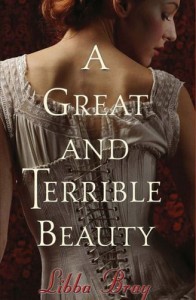
A Great and Terrible Beauty
A GREAT AND TERRIBLE BEAUTY by Libba Bray (Simon & Schuster, 2003)
GENRE: Historical Romance w/ paranormal elements
HONORS: NY Times Best-Seller
REVIEW: There were not many options for girls in Victorian society, a fact that becomes obvious to sixteen-year-old Gemma Doyle upon her arrival at the Spence Academy. Initially socially marginalized, Gemma gradually befriends three other girls, even as she begins to experience disturbing visions that place her in the center of a mystery that followed her to London from the streets of India, where her beautiful mother died. A Great and Terrible Beauty reads like part gothic romance and part Victorian pulp with a healthy dose of the paranormal added to spice things up. There's of occult danger and Eastern 'otherness' (both sexy and mildly threatening to a respectable, young Englishwoman) and enough lurid drama to keep any tween / teen gobbling it down. Despite Bray's use of the first person present progressive tense, which gets tiresome at times, A Great and Terrible Beauty is a great deal of fun and surprisingly hard to put down.
OPINION: Libba Bray knows young women. Gemma Doyle is a good heroine, as far as historical fiction goes - she's active, she has agency, she's flawed but passionate. There's a fair amount of conflict and fight in her, which makes her easy for a modern girl to relate to. Gemma's friends are also interesting - the drab, unattractive Ann (who is a cutter, due in large part to her implied depression and alienation), the gorgeous, ornamental Pippa and Felicity, who, of the four, is the most complex.
IDEAS: The first in the Gemma Doyle trilogy, A Great and Terrible Beauty is a solid suggestion for girls looking for historical romance and / or drama. Though not necessarily for reluctant readers, the book appeals on a lot of levels, even as Bray explores serious issues like alienation, autonomy and the historical role of women and girls. A nice choice for a free reading title or as a book club selection - it has a lot of discussion points.
GENRE: Historical Romance w/ paranormal elements
HONORS: NY Times Best-Seller
REVIEW: There were not many options for girls in Victorian society, a fact that becomes obvious to sixteen-year-old Gemma Doyle upon her arrival at the Spence Academy. Initially socially marginalized, Gemma gradually befriends three other girls, even as she begins to experience disturbing visions that place her in the center of a mystery that followed her to London from the streets of India, where her beautiful mother died. A Great and Terrible Beauty reads like part gothic romance and part Victorian pulp with a healthy dose of the paranormal added to spice things up. There's of occult danger and Eastern 'otherness' (both sexy and mildly threatening to a respectable, young Englishwoman) and enough lurid drama to keep any tween / teen gobbling it down. Despite Bray's use of the first person present progressive tense, which gets tiresome at times, A Great and Terrible Beauty is a great deal of fun and surprisingly hard to put down.
OPINION: Libba Bray knows young women. Gemma Doyle is a good heroine, as far as historical fiction goes - she's active, she has agency, she's flawed but passionate. There's a fair amount of conflict and fight in her, which makes her easy for a modern girl to relate to. Gemma's friends are also interesting - the drab, unattractive Ann (who is a cutter, due in large part to her implied depression and alienation), the gorgeous, ornamental Pippa and Felicity, who, of the four, is the most complex.
A Great and Terrible Beauty is fun, dark, a little edgy and sexy in a safely historical way. It's strength lies in the fact that all four of the girls, Gemma, Pippa, Ann, and especially Felicity, want autonomy - they want to valued for themselves and, in their own way, they fight for that privilege in a Victorian world that valued silence in its women and girls. For that alone, A Great and Terrible Beauty is worth reading.
IDEAS: The first in the Gemma Doyle trilogy, A Great and Terrible Beauty is a solid suggestion for girls looking for historical romance and / or drama. Though not necessarily for reluctant readers, the book appeals on a lot of levels, even as Bray explores serious issues like alienation, autonomy and the historical role of women and girls. A nice choice for a free reading title or as a book club selection - it has a lot of discussion points.
July 31, 2012
The Girl Who Circumnavigated Fairyland in a Ship of Her Own Making
THE GIRL WHO CIRCUMNAVIGATED FAIRYLAND IN A SHIP OF HER OWN MAKING by Catherynne M. Valente; Illustrated by Ana Juan (Square Fish, 2012)
GENRE: Fantasy / Fairytale
HONORS: Andre Norton Award
REVIEW: While washing pink and yellow teacups in her kitchen sink, September is offered the chance to ride the Leopard of Gentle Breezes to Fairyland with the Green Wind, a natty and mischievous individual. September, who is not only tired of washing teacups, but of Nebraska and of normal life in general, accepts, embarking on an adventure that takes her to Pandemonium, (the capital of Fairyland) and the home of the evil Marquess, to the Autumn territories where it is always Halloween, around the whole of Fairyland in her titular ship and finally to the Lonely Jail, where all is explained. Along the way, she meets a girl made of soap, a Wyverary (a Wyvern that is half library), witches, pookahs, alchemists, velocipedes, a boy named Saturday and her own Death. While drawing liberally on motifs and themes from multiple fairy tales, Valente manages to construct a story that is both linguistically beautiful and completely unique. September's journey lands her in unexpected and oddly familiar places, while the climax, though (in hindsight) is perfectly, constructed and inevitable, still manages to surprise. A gorgeous and truly special book, The Girl Who Circumnavigated Fairyland in a Ship of Her Own Making is a lovely, jewel of a thing, full of enough adventure and emotional resonance to have readers gobbling it up like fairy food.
OPINION: This is, so far, my favorite book of the semester. Valente's narrative voice is playful and sure, drawsing on old-fashioned language and conceits (such as asides to the reader) that in her hands feels fresh and new. Everything about September's story vibrates with energy and color, but what makes it stand out, particularly, is the emotional depth operating beneath the visual and linguistic loveliness. Themes of loneliness, fear and regret play out gracefully to the end, making The Girl Who Circumnavigated Fairyland in a Ship of Her Own Making much more than just a charming face.
IDEAS: A good suggestion for slightly older tweens with the ability to focus on language. While not a difficult read, it does require a bit of focus and maturity from the reader. It would be especially fun for tweens who enjoy fairy tales and classics like Alice's Adventures in Wonderland as Valente refers to many of them thematically and stylistically throughout. Also a wonderful choice for a library or school book club, where an adult could help lead discussions on any number of possible topics.
July 27, 2012
The 13 Clocks
THE 13 CLOCKS by James Thurber; Illustrated by Marc Simont; Introduction by Neil Gaiman (New York Review Children's Collection, 1950)
GENRE: Fantasy / Humor / Fairy Tale
HONORS: None
REVIEW: High up in a castle, an evil Duke (who is so cold that even the hands of his 13 clocks have frozen at "ten minutes to five") lives with his beautiful niece, Princess Seralinda. Loathe to lose her to marriage, the Duke devises all manner of impossible quests for the suitors who come knocking at his castle door. It is only when Xingu, a "knight who is not a knight" learns of the lovely Seralinda and undertakes a quest to win her hand in marriage, that the Duke overthrown and justice served. Thoroughly intelligent and charmingly ridiculous, The 13 Clocks takes full advantage of an entire host of fairy tales. Though it won't appeal to every reader, for those who enjoy a touch of the ridiculous, light romance, fairy tales or complex puns it is a wonderful, surprising read.
OPINION: The 13 Clocks is a quick read that works on several levels. For younger adolescents, the story alone, with it's fabulous villain, lovely princess and intrepid knight, is a fun romp through territory littered with familiar fairy tale motifs. For older tweens, or those who read more closely, Thurber's word play and internal pacing give The 13 Clocks and extra degree of interest. One could read this book several times and still not catch every double-meaning or subtle joke, making it a subtly ridiculous, utterly engrossing read for a wide range of tweens. Neil Gaiman's introduction adds a nice bit of context for the modern reader, as well.
IDEAS: Great for fans of Roald Dahl's satirical style and work play. Also an unexpected suggestion for fans of fairy tales and knightly romance, particularly for those who enjoy a dash of humor and a touch of the ridiculous. In the classroom, a nice vehicle for discussion about folklore and fairy tale motifs and themes.
The Rose and the Beast
THE ROSE AND THE BEAST by Francesca Lia Block (Harper Collins, 2000)
GENRE: Fantasy / Fairy Tales
HONORS: L.A. Times Best Seller
REVIEW: The Rose and the Beast is an unexpected collection. Each story is an adaptation of a fairy tale ranging from the popular, ("Snow," a variation on Snow White) to the less well-known, ("Bones," Block's Bluebeard). As in much of Francesca Lia Block's work, the language is lovely and poetic, with a nebulous quality that gives each story the feeling a Impressionist painting. Though not immediately obvious in most cases, the original tales form strong foundation for each adaptation, providing Block with a platform on which to explore themes such as the variable nature of love and friendship, as well as darker issues, such as abuse and alienation. More appropriate for adolescents 13 and over, The Rose and the Beast is a subtle, emotional collection, one that deals with potentially difficult subject matter, while rarely handing the reader a clear-cut solution to any of the situations depicted. That said, the stories are haunting and beautiful, and will reward the reader who takes the time to sit and ponder them.
OPINION: This is a wonderful collection of literary fairy tale adaptations. Each story, written with Block's characteristic linguistic care, skims the surface of the original, while hinting at the depths beneath. A strong addition to any tween collection, it is a book that requires the reader's full emotional and intellectual attention. It would probably be most enjoyed by readers already familiar with the world of fairy tales and their adaptations and / or fans of Block's other work.
IDEAS: A great book for comparative discussion. The tales of full of hints, clues and variations on the original fairy tales that inspired them. Also a great suggestion for fans of Block's other collections, particularly Girl Goddess #9 and How to (un)Cage a Girl.
July 16, 2012
Mirror, Mirror
MIRROR, MIRROR by Marilyn Singer; Illustrated by Josee Masse (Dutton, 2010)
GENRE: Poetry / Fantasy
HONORS: None
REVIEW: Marilyn Singer plays with an interesting concept in Mirror, Mirror. The poems are all distillations of familiar fairy tales, but the verse is "reversible," which is where things get slightly dicey. The concept of reversible verse is a good one. The poems are meant to have different meanings, depending on whether or not one is reading them front to back or back to front. To aid in this exercise, Singer presents the two versions of each poem side by side as mirror images of the other. Many of the reversals are quite successful, (Rapunzel and Cinderella particularly stand out), but others, (like the Red Riding Hood poem among several others), work well enough in one direction but become forced and nonsensical in the other. That said, Josee Masse's illustrations are lovely, with lush colors and pleasingly rounded, clean lines. Each story receives an illustration and each illustration captures the essence of both the original tale and Singer's poem with charming efficiency. As distillations of well-known stories, the poems are easy to enjoy.
OPINION: Overall, Mirror, Mirror is very good book and an excellent way to encourage tweens resistant to poetry to give it a try. The tales are familiar and intriguingly presented, providing plenty of opportunity for discussion and individual interpretation. The illustrations are warm and inviting, while the puzzle-like nature of the verse gives the poems a playful quality that belies many kids' assumption that poetry is stuffy and unwelcoming.
IDEAS: Selections of Mirror, Mirror would make a nice addition to classroom discussions on fairy tales and / or poetic form, so long as you cherry-pick a handful rather than present the whole.
July 10, 2012
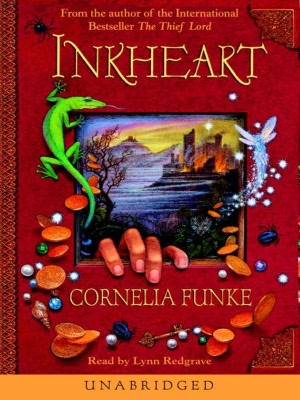
Inkheart
INKHEART by Cornelia Funke; Read by Lynn Redgrave. (Learning Library Audio, 2005)
GENRE: Adventure / Audiobook
HONORS: None
REVIEW: Inkheart is the story of a girl, Meggie, her bookbinder father, Mo, and the trouble that lands on their doorstep when a figure from Mo's past arrives one rainy night. Though exquisitely detailed with adventures and secrets and nefarious doings and hard-won triumphs, Inkheart is, in the end, a love note to books. Meggie is a born reader with a reverence for the printed page that she inherited (along with a slightly more dangerous gift) from her father. Solace and comfort are found between the pages of various stories, which is interesting because the novel's greatest villain also springs forth from the written word. Though overlong at times, (the book sometimes stalls under the weight of Funke's admittedly beautiful descriptions), Inkheart is a pleasure - truly engrossing, charmingly adventurous and satsifyingly resolved. The audiobook also has the advantage of being read by Lynn Redgrave whose vocal performance is nuanced, varied and masterful. Somehow she manages to sound equally convincing as an illiterate thug as she does as a twelve-year old girl. A real treat.
OPINION: The novel is tailor made for younger tweens hungering for an "epic" series to try. Though the action is dark at times, and genuinely a bit frightening, the story follows many of the tropes established in the books that Meggie so loves. In this way, Inkheart is oddly comforting, even as it keeps you on your toes.
IDEAS: A wonderful suggestion for reluctant readers, boys and girls alike. Also a great pick for a tween book club, especially if the members tend towards the younger side.
July 9, 2012
Percy Jackson and the Olympians: The Lighting Thief
PERCY JACKSON & THE OLYMPIANS:
THE LIGHTENING THIEF. Film adaptation. (Directed by Chris Columbus. Starring
Logan Lerhman. Based on the novels by Rick Riorden)
GENRE: Action / Adventure
HONORS: None
REVIEW: The film adaptation of
Rick Riorden’s best-selling series, Percy Jackson and the Olympians, moves at an efficient pace while maintaining the essence
of what makes the books so appealing – Percy’s struggle to manage himself in
the wider world. Lehrman plays Percy, demigod and son of Poseiden, with modern
flair, mixing enough defiance into Percy’s geekiness to make him an appealing
underdog with plenty of fight. Grover, his satyr "protector", grounds
Percy’s quest in contextual gravity while providing comic relief, while
Annabeth, the battle-ready daughter of Athena is a nice foil for Percy, who is
literally dropped into his new reality when a Fury accosts him. Upon learning
of his true heritage, Percy rises to the challenge and proves himself to be a
natural hero with what seems to be, at times, convenient ease.
OPINION: The emotional core of Percy
Jackson and the Lightening Thief rang
hollow at times and it lacks the world-building creativity of other series
adaptations, but it is still a satisfying ride that will no doubt appeal to
fans of the books.
IDEAS: A strong addition to any
unit on Greek mythology or hero quests. Show the film and talk about parallels
between Percy’s quest and the mythological quests it draws from (Odysseus and
the lotus-eaters, Perseus and Medusa, Orpheus in Hades, etc.). There is also an
inherent appeal for kids with dyslexia and ADHD as Percy struggles with these
conditions before discovering that he is a hero.
July 6, 2012
House of Dolls
HOUSE OF DOLLS by Francesca Lia Block (Harper, 2010)
GENRE: Contemporary (with fantastic elements)
HONORS: None
REVIEW: High up in a penthouse, twelve-year-old Madison
Blackberry lives, angry, ignored and jealous of the three dolls who live in the
elaborate dollhouse that used to belong to her grandmother. The dolls,
Rockstar, Wildflower and Miss Selene, live in peace with their boyfriends (Guy
and B Friend), though they fear Madison’s boredom and caprice. And they’re
right to fear. After Madison sends Guy off to “war” (a shoebox in the closet)
and B Friend is declared MIA, Madison systematically dismantles the dolls’
world, hiding their lovely clothes until they are as shabby and neglected as
she feels. It is only through Wildflower’s understanding and compassion that
Madison’s anger is addressed and that balance is restored both to Madison’s
life and the dollhouse.
OPINION: Though House of Dolls is a slender, deceptively simple story, Block manages
to address an impressive number of issues with a light, effective hand.
Madison’s need to feel loved and her resulting disappointment manifest as
violence – a nice microcosmic metaphor for a macrocosmic problem. Though the
dolls are sentient, the book does not feel like fantasy. Magical and lovely
though it is, it is grounded in a deep realism, one that will reward repeated
readings as a young person grows older.
IDEAS: Though the story is short and relatively
straightforward, Block uses language to its full extent, conveying
sophisticated thoughts on love, life, war and death in lightly philosophical
term terms. It is an excellent volume for slightly older tween ready to step
her reading up a notch, while enjoying a quick, compelling story.
Matilda
MATILDA by Roald Dahl,
illustrations by Quentin Blake (Puffin Modern Classics, 1988).
GENRE: Humor (satirical, slightly biting)
HONORS: Federation of Children's Group Award (UK 1988)
REVIEW: Matilda is an
exceptionally gifted five year-old, able to read and do mathematics well above
her grade level. She is also the daughter of two exceptionally rotten parents,
but despite her less-than-ideal home life, she is sweet, unassuming and
surprisingly wise. The book Matilda, though
charming in its own right (as most of Dahl’s work is), is in-and-of-itself
exceptional, because of it’s exceptional heroine. As Matilda good naturedly
sets out to do everything from read the classics to avenging her beloved
teacher, Miss Honey, the reader is propelled along by a compulsion to see how
Matilda will handle herself. And one is never disappointed.
OPINION: Matilda occupies a territory that is difficult to define – it is
humorous without being expressly funny and it passes fluidly back and forth
between the realistic and fantastic – and yet, Dahl never falters. The story is
seamless and his heroine is a delight from start to finish. Though younger
adolescents may get more out of reading it with an adult (some of the
vocabulary and phrasings may prove challenging), most will gobble the story up
as Matilda gets hers over the wretched Wormwoods and the horrific Miss
Trunchbull.
IDEAS: Matilda would be a great suggestion for a summer reading program.
It would also do well in a display of books that celebrate reading (along with
the Inkheart series, etc.)
Courtney Crumrin and the Night Things
COURTNEY CRUMRIN AND THE NIGHT THINGS by Ted Naifeh (Oni
Press, 2002)
GENRE: Graphic Novel
HONORS: Eisner Award nominations – One for Best Limited
Series (2003); One for Best Title for Younger Audience (2005)
REVIEW: Courtney Crumrin and the Night Things is the first volume in the three volume series that
chronicles the not-so-normal everyday life of a loner girl who learns magic
from her mysterious uncle and uses it to navigate a world of school bullies and
bloodthirsty goblins and adolescent peer pressure. Throughout her adventures,
Courtney displays ingenuity and intelligence, qualities that see her through
some truly strange things (a good-girl doppelganger, goblins stealing a baby
she’s sitting, etc). But though she is independent, strong and loyal, Courtney
is far from perfect – she’s sarcastic and grumpy too, making her a fantastically
real adolescent heroine. The world she inhabits is, by turns, normal to the
point of banality, as well as gothic and creepy. Thanks to Neifeh’s clean,
expressive illustrations (everyone but Courtney, Uncle Aloysius and select
Night Things have vacant, empty eyes – a nice commentary on how Courtney feels
about “normal”, suburban life), it’s a world that the reader can’t help but
want to enter.
OPINION: Courtney Crumrin and the Night Things is excellent on several levels – the stories are fast-paced, engrossing and easy to read, making it a great selection for reluctant readers; and the subject matter veers elegantly between the fantastic (spells gone wrong) to the very real (bullying and isolation). It’s simply too good not to have in a library’s tween collection.
IDEAS: Excellent recommendation for reluctant readers or tweens with an alternative vibe, great addition to any graphic novel display, particularly with other, darker / alternative stories like Gloomcookie and any of Neil Gaiman’s work.
The Magician's Elephant
GENRE: Fantasy
HONORS: Booklist Editor's Choice, 2007
REVIEW: The Magician’s Elephant concerns
a boy whose greatest wish is to know if the sister is still alive. A
fortune-teller reveals that she is, and that to find her, he must "follow
the elephant." While the boy, Peter Augustus Duchene, is very much the
protagonist, DiCamillo takes full advantage of her omniscient narrator by also
presenting the perspectives of the lost sister, the magician (who is imprisoned
after the elephant falls on a noblewoman), a kind police inspector, and even
the elephant herself. She does so fluidly - the changes in perspective feel
very natural to the narrative - and in doing so, allows this simple story to
take on a universality that is gently appealing.
OPINION: The Magician's
Elephant doesn't read as fantasy, but it
does have a whimsical sense of the fabulous which makes you feel like your
reading a story much older than it is. Though not an overly dynamic book it is
lovely, full of warm shadows and inevitable magic.
IDEAS: The Magician’s Elephant is a
good book for kids ready for a book to draw inferences and make connections but
that is not too long or complex. The fortune teller’s mysterious message and
what follows are unusual enough to attract some reluctant readers, as well.
Coraline
CORALINE by Neil Gaiman
(Harper, 2002)
GENRE: Contemporary /
Horror
HONORS: SLJ Best Book; HUGO
Award for Best Novella; ALA Notable Children’s Book; ALA Best Book for Young
Adults; Bram Stoker Award for Best Work for Young Readers
REVIEW: Coraline, a very
modern, very smart and very bored girl, finds a hidden door in her new house.
On the other side is an "other" world, with an alternate version of
her parents. The alternate parents are attentive and ideal - except for their
black button eyes. Coraline is wary and she is right to be so. The alternate
world works hard to draw her back, and the real world grows creepier and more
foreboding as a result. Gaiman displays impressive control, despite the fact
that the story mines very fertile ground. His plotting and prose are tight and
lucid, and Coraline is a compelling heroine. Wise and brave, she defeats evil
through cleverness and, in a subtle stroke at the end, learns not to be bored
in the mundane world.
OPINION: I loved Coraline's creepiness. The pacing and overall plot worked
seamlessly to create a world in which oddities, taken individually, appear to
be benign, but taken collectively represent a great threat.
IDEAS: More sophisticated
than Goosebumps and other such fare, Coraline is an engrossing, easy-to-read alternative for kids ready
to move on to a slightly subtler form of scary.
July 5, 2012
Ella Enchanted
GENRE: Fantasy
HONORS: Newbery Honor, ALA Notable Children’s Book, ALA Best
Book for Young Adults, ALA Booklist Editors’ Choice, Publisher’s Weekly Best
Book
REVIEW: When Ella of Frell is born, the fairy Lucinda bestows a gift upon her – the gift of obedience – which turns out to be a terrible curse. As a result, Ella must find ways to assert herself despite the constant threat of obedience (if someone told her to cut off her head, she would have to). Ella’s naturally independent nature grows stronger with every challenge, despite, or perhaps because of, the curse. A clever, genuinely funny adaptation on the Cinderella tale, Ella Enchanted is the story of a cursed girl who becomes a woman capable of saving herself.
OPINION: This is a wonderful book for reluctant YA and tween readers – especially girls. The story is just recognizable enough to feel familiar to anyone who has heard Cinderella, but it deviates substantially from the classic girl-as-victim plot, giving the reader a spunky, empowering heroine she can relate to. The humor, romantic elements, and first-person narrative make it a truly accessible, pleasant read.
IDEAS: Would be a great edition to a themed book club (fantasy or fairy tale adaptations in particular, which are popular right now).
Subscribe to:
Posts (Atom)