August 20, 2012

The Adventures of Sir Balin the Ill-Fated

THE ADVENTURES OF SIR BALIN THE ILL-FATED by Gerald Morris; Illustrated by Aaron Renier, (Houghton Mifflin, 2012)
GENRE: Adventure
AGE: 9 and up

Oh Sir Balin, you carry the heavy weight of destiny upon your noble shoulders. But can and should you trust the Old Woman of the Indeterminate Mountain's prophecy, especially when the Prophetess Guild's standards have been flagging of late? How much of destiny is predetermined? How much of your fate is really yours to control?

Gerald Morris, Arthurian scholar and author of The Squire's Tale series for younger readers, peppers his newest installment of the popular Knight's Tale series, The Adventures of Sir Balin the Ill-Fated, with these questions, but never to the detriment of good, irreverent fun. When an old woman makes a prophesy over Balin's cradle that he will become known as the noblest knight in the land, but that misfortune will follow in his wake, it colors his future, so much so that the prophecy becomes self-fulfilling. Then Annalise, The Questing Lady, and Balin's older brother, Sir Balan (their mother wanted a matched set), help Sir Balin see past the seemingly air-tight pattern of unfortunate events that comprise his knighthood to the possibility that his destiny is his to make.

Though the tale of Sir Balin has its roots traditional Arthurian tales, Morris's irreverent voice and colloquial dialogue bring the story galloping into the 21st century. With details that would be at home in a Monty Python sketch (there's a bit where various knights suggest ways of releasing a magical sword from it's scabbard - jiggling the hilt and bacon grease figure in), the general tone of silly fun is an excellent balance for Morris's age-appropriate ruminations on the nature of fate. Additionally leavened by Aaron Renier's clobberingly comedic illustrations, The Adventures of Sir Balin the Ill-Fated is a quick read and a serious, but not too serious, winner.

August 13, 2012

Bella at Midnight

BELLA AT MIDNIGHT by Diane Stanley (Harper Collins, 2006)
GENRE: Historical Romance - Fairy Tale
AGE: 10 and up

Firmly constructed on Cinderella's framework, Diane Stanley nevertheless manages to bring a fresh approach to the classic tale with her novel, Bella at Midnight. In this version, the heroine, Bella, though a knight's daughter, is fostered to a family of peasants, who lovingly raise her until her thirteenth year. When her father recalls her home, she is little prepared for her new life as a lady and the coldness of her father's home. However, Bella is kind and spirited. When she learns of a plot that threatens Prince Julian, her childhood friend, she embarks on a quest to save him aided only by her godmother, an enchanted ring and a pair of lovely glass slippers. Bella's success in the endeavor, however, has less to do with magical objects, and everything to do with the strength of her character.

Stanley's take on this familiar tale is distinctly historical in nature. Although the two warring countries are fictional, they bear great similarities to standard, medieval European societies, and though magic is not completely absent from the plot (the enchanted ring does reassure at critical moments), enchantments are, for the most part, underplayed. Stanley's narrative structure is one of alternating viewpoints, and though Bella receives more chapters than any other character, her point of view is most certainly not the only one (Prince Julian, her godmother, her foster mother and even her resentful, ill-treated stepmother and mute stepsister receive chapters of their own). For the most part, this convention works, lending the novel as scope that it otherwise would not have. Unfortunately, it also suffers from muted tensions and dulled focus because of it (nearly 80 pages are told from the stepmother's and stepsisters' points of view, lending them an excellent, interesting backstory but diluting the main thrust of the plot). That said, Stanley navigates her material deliberately, giving the reader a climax that elegantly ties up loose ends. The romance, though sweet, is underdeveloped and slightly tepid, though these very qualities make it appropriate for tweens not yet prepared for more intense relationships. Overall, it is an interesting alternative to more traditional Cinderellas, one that I wouldn't hesitate to recommend for it's discussion value alone.


August 9, 2012

When You Reach Me

WHEN YOU REACH ME by Rebecca Stead (Yearling, 2009)
GENRE: Science Fiction / Mystery - Literary
HONORS: Newbery Medal; Boston Globe - Horn Book Award for Fiction; many others, including multiple best-seller and best-of-the-year lists

REVIEW: When You Reach Me begins with Miranda, a sixth grader in 1978, and a postcard informing her mother that she is to be a contestant on The $20,000 Pyramid. Miranda addresses the reader directly as she recounts the events of the year, from the time she receives the first of a series of unsettling notes, to the end of the year, when a death occurs and she slowly puzzles out the mystery of who has been leaving her the notes and why. Stead leans somewhat heavily on Miranda's favorite book, Madeleine L'Engle's A Wrinkle in Time, using this classic to seed the notion of non-linear time and travel between dimensions, (the material is strong enough on it's own that a few simple allusions would have sufficed). That said, the way Stead slowly reveals the purpose behind the notes and their sender is a thing of beauty, intricate and controlled. With a climax that is tremendously effecting and a denouement that stays with you long after the book is over, When You Reach Me is a beautifully crafted book, one that will challenge it's readers as well as reward.

OPINION: When You Reach Me is an unexpected puzzle-box. Miranda is a trustworthy narrator, guiding the reader faithfully through the story's non-linear, threads. Though the book requires a certain amount of maturity and patience on the part of the reader, it is quietly profound - the sort of book you remember reading decades later. With it's blend of L'Engle inspired science fiction and social realism, it is impressive, relevant and entirely deserving of the accolades it's received.

IDEAS: A great book for fans of A Wrinkle in Time, (the novel reads, in some ways, as a love letter to L'Engle's classic work). One might recommend reading both, back to back, and then comparing the two. Which elements of A Wrinkle in Time appear prominently in When You Reach Me? Would the novel be as strong without it's foundational allusions to L'Engle's classic? Why do you think Stead chose to weave it so strongly into this novel? Why is it important that it is Miranda's favorite book?

The Dark is Rising

THE DARK IS RISING by Susan Cooper (Scholastic, 1974)
GENRE: Fantasy
HONORS: Newbery Honor (1974)

REVIEW: On his eleventh birthday, Will Stanton, the seventh son of a seventh son, finds out that he is an Old One, an ancient race of beings who keep the Dark at bay in the name of the Light. No sooner does Will discover that his true purpose as the Seeker, the Old One destined to unite the Things of Power, than he is plunged into the battle between Light and Dark, Good and Evil. The story follows Will as he collects the Six Signs to form the Circle, pursued by the Black Rider, an agent of Darkness, and added by Merriman Lyon, The Lady and other Old Ones who have been fighting the Dark for centuries. Peppered with elements from Celtic myth and Arthurian legend, The Dark is Rising (the second in The Dark is Rising Sequence) is a layered and thoughtful combination of old myth, fantasy and contemporary suspense. It is a book that rewards focus and attention, even while giving it's readers an entertaining, satisfying ride.

OPINION: Beautifully written and briskly paced, The Dark is Rising, smacks of literary quality even as its premise is rooted firmly in the fantasy tradition. Will is a compelling hero - mature, smart, savvy and slightly flawed. He is a kid that most readers would want to be, or at least be friends with. His growth over the course of the novel, spurred primarily through his expanding view of the world, is one that many young readers will identify with, even if they themselves are unlikely to battle the Dark or call on the Wild Hunt for assistance. A tween fantasy classic for a reason, it is arguably the strongest title in The Dark is Rising Sequence, one that stands firmly on it's own.

IDEAS: A wonderful tie in to units on world mythology, particularly Celtic mythology and Arthurian legend. Also a good way to introduce theme, symbolism and allusion. A great recommendation to kids who need to read a Newbery book, but who are more interested in genre fiction than realism. This book has stood the test of time and still feels urgent and contemporary.

August 7, 2012

Among the Hidden

AMONG THE HIDDEN by Margaret Peterson Haddix (Simon & Schuster, 2008)
GENRE: Science Fiction - Dystopia
HONORS: None

REVIEW: In a society in which the number of children per family is limited to two, Luke Garner is a third child, a shadowchild, a child whose very existence is illegal. When the forest surrounding his parents' farm is felled to make way for a housing development for the society's ruling class, Luke must stay hidden, never leaving the house and, eventually, never leaving his attic room. But Luke does leave, and in the process he meets Jen, another third child, the daughter of a rich and powerful Baron, with justice, equality and revolution on her mind. Over the course of their friendship, Luke begins to understand the limitations of his life and learn the courage to hope for more. Haddix's totalitarian dystopia borrows heavily from China's One Child Act, (according to the author, it helped inspire the concept of the book). Though underdeveloped at times (there are questions about the Government's true reach and the society's Population Police that, if answered, would have heighten tensions), Among the Hidden is a compellingly fast read that inspires questions and thought in the reader.

OPINION: Though not as meaty or deeply conceived as the Panem of Suzanne Collins's Hunger Games trilogy, Among the Hidden has much to offer the fans of dystopic fiction. Often overwhelmed and under-informed, Luke is a sympathetic protagonist, ultimately overcoming the hesitation that twelve-years of hiding has bred in him. His relationships - to his mother, to his own frustration, to his doomed friend, Jen - make his story easy to invest in. Overall, a thought-provoking read that will leave reader's curious enough to continue with the rest of the series.

IDEAS: A great suggestion for readers a little too young for The Hunger Games but interested in stories set in dystopias (the fact that it's part of a series means there's a lot to get hooked on). Also a nice, less expected choice for a science fiction display or science fiction book club. The fact that the protagonist is a boy will also help it appeal to male tweens.

August 6, 2012

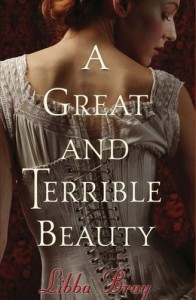
A Great and Terrible Beauty

A GREAT AND TERRIBLE BEAUTY by Libba Bray (Simon & Schuster, 2003)
GENRE: Historical Romance w/ paranormal elements
HONORS: NY Times Best-Seller

REVIEW: There were not many options for girls in Victorian society, a fact that becomes obvious to sixteen-year-old Gemma Doyle upon her arrival at the Spence Academy. Initially socially marginalized, Gemma gradually befriends three other girls, even as she begins to experience disturbing visions that place her in the center of a mystery that followed her to London from the streets of India, where her beautiful mother died. A Great and Terrible Beauty reads like part gothic romance and part Victorian pulp with a healthy dose of the paranormal added to spice things up. There's of occult danger and Eastern 'otherness' (both sexy and mildly threatening to a respectable, young Englishwoman) and enough lurid drama to keep any tween / teen gobbling it down. Despite Bray's use of the first person present progressive tense, which gets tiresome at times, A Great and Terrible Beauty is a great deal of fun and surprisingly hard to put down.

OPINION: Libba Bray knows young women. Gemma Doyle is a good heroine, as far as historical fiction goes - she's active, she has agency, she's flawed but passionate. There's a fair amount of conflict and fight in her, which makes her easy for a modern girl to relate to. Gemma's friends are also interesting - the drab, unattractive Ann (who is a cutter, due in large part to her implied depression and alienation), the gorgeous, ornamental Pippa and Felicity, who, of the four, is the most complex.

A Great and Terrible Beauty is fun, dark, a little edgy and sexy in a safely historical way. It's strength lies in the fact that all four of the girls, Gemma, Pippa, Ann, and especially Felicity, want autonomy - they want to valued for themselves and, in their own way, they fight for that privilege in a Victorian world that valued silence in its women and girls. For that alone, A Great and Terrible Beauty is worth reading.

IDEAS: The first in the Gemma Doyle trilogy, A Great and Terrible Beauty is a solid suggestion for girls looking for historical romance and / or drama. Though not necessarily for reluctant readers, the book appeals on a lot of levels, even as Bray explores serious issues like alienation, autonomy and the historical role of women and girls. A nice choice for a free reading title or as a book club selection - it has a lot of discussion points.


August 3, 2012

My Depression: A Picture Book

MY DEPRESSION: A Picture Book by Elizabeth Swados (Hyperion, 2005)
GENRE: Nonfiction - Autobiography
HONORS: None

REVIEW: Depression is a difficult topic and there are very few books written for tweens on the subject. Though My Depression: A Picture Book is written by an adult with an adult audience in mind, there are many aspects of her story that will resonate with tweens struggling to understand the condition. Swados writes about depression frankly, as one who has struggled with the condition since she herself was an adolescent. Her illustrations are raw, evocative and gently humorous, underscoring her minimal text and the emotional difficulties of traveling through a depressive episode and successfully reaching the other side. Swados deals with everything from onset and coping mechanisms to social difficulties and treatment options without falling into the trap of recommending a cure - lots of things work, you just have to be patient and find what works for you. With an absolute lack of judgement, Swados delivers an encouraging message from a person with first hand experience.

OPINION: Certain topics in Swados's story may be inappropriate for younger adolescents (she briefly addresses suicide - though in such as way that emphasizes the many reasons she chose not to. Also mentioned are smoking and drinking as initial coping mechanisms). As such, it's a book that should be recommended and read with care. For older adolescents, particularly those who can read the book and discuss it with a trusted adult, My Depression: A Picture Book is an enlightening, encouraging and nourishing read, filled with sensitivity, frankness and the gentle humor of a person who has been there and made it through.

IDEAS: Unless dealing with a tween or teen that you know quite well,  this My Depression:  A Picture Book is best recommended to parents / caregivers by librarians (counselors and professionals often recommend it directly, but for nonprofessionals, caution is best). Though blatantly encouraging (the ability to draw strength from depression is repeatedly underscored, while Swados's positive attitude communicates strong authorial support), for older adolescents, it is still a book ideally read with the support of someone else.